
The Frato Latitude sectional is the model for open-plan living rooms where the seating has to define a zone without walls. Cream bouclé, low profile, generous chaise, deep seats. The shape carries panoramic window views and city skyline backdrops in a way that smaller sofas cannot. This review covers what the Latitude 3D model gets right and where the sectional format works against the render.
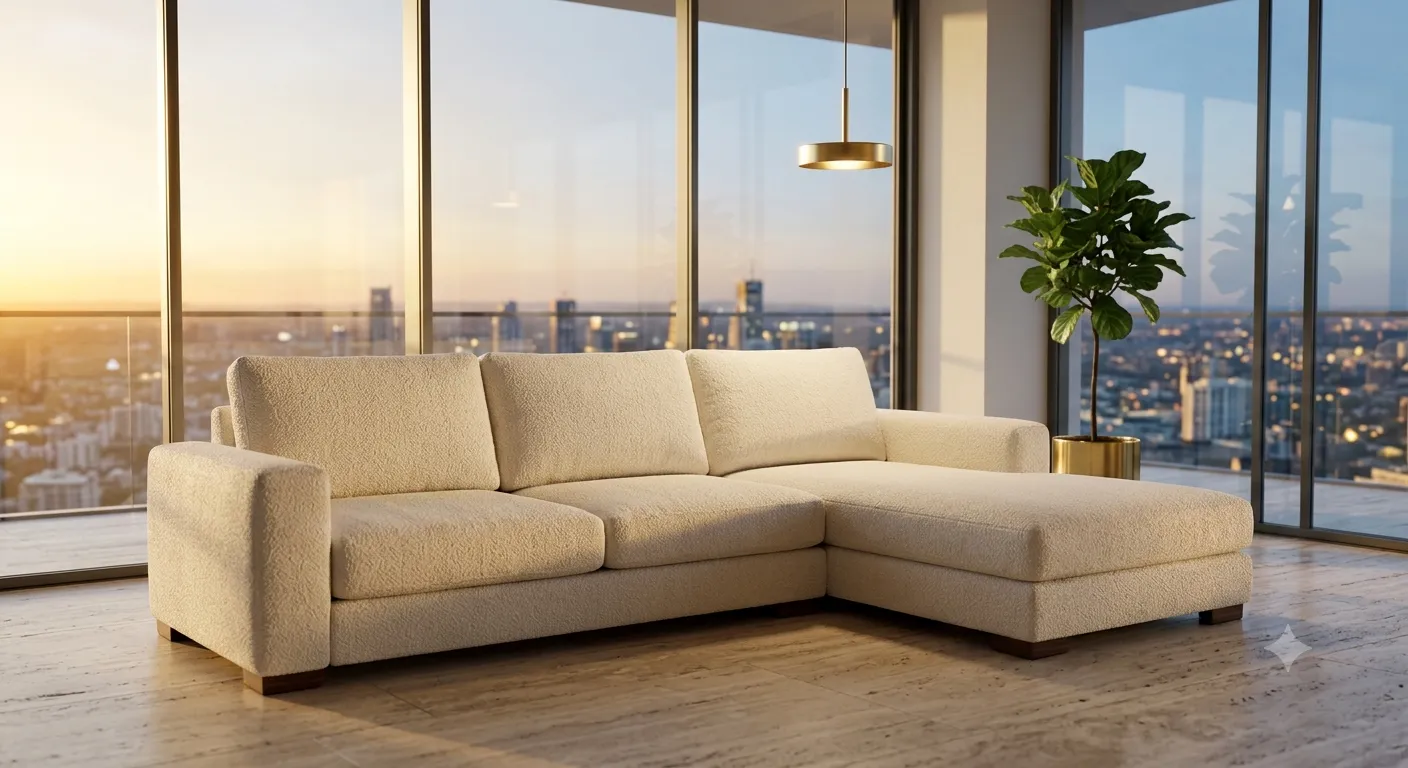
What the Latitude silhouette brings to a render
The Latitude is a low, deep-seated sectional with a continuous seat platform, individual cushions, and a chaise extension that breaks the L-shape into a usable recline. The silhouette is intentionally horizontal — the sofa reads as a long, low gesture across the room. This is the shape that lets an open-plan composition settle.
An open-plan living room needs a sofa that defines the seating zone without filling it. The Latitude is built for exactly that brief.
The bouclé fabric is the design language. The texture has visible weave variation in the diffuse map, a high-frequency normal for the loop structure, and a roughness profile that catches light at glancing angles without becoming shiny. None of this is faked — the material is built for the cream bouclé palette and stays disciplined when the color is changed.
L-shape and chaise configurations
The Latitude ships in three editable configurations: standard L-shape, mirror L-shape (left vs right chaise), and straight sectional without chaise. For a render, the configuration choice is more important than the fabric choice. A chaise that opens toward the camera reads as inviting; a chaise that opens away from the camera reads as wasted space.
- Standard L-shape: chaise on the right when viewed from the camera, opens into the seating zone.
- Mirror L-shape: chaise on the left, for compositions where the seating needs to anchor the opposite wall.
- Straight sectional: no chaise, for narrow open-plan rooms or compositions where the chaise competes with a feature wall.
The model is built so the chaise can be removed from the L-shape configurations without rebuilding geometry — the chaise is a separate editable group, not a fused extension.
Material setup and fabric variants
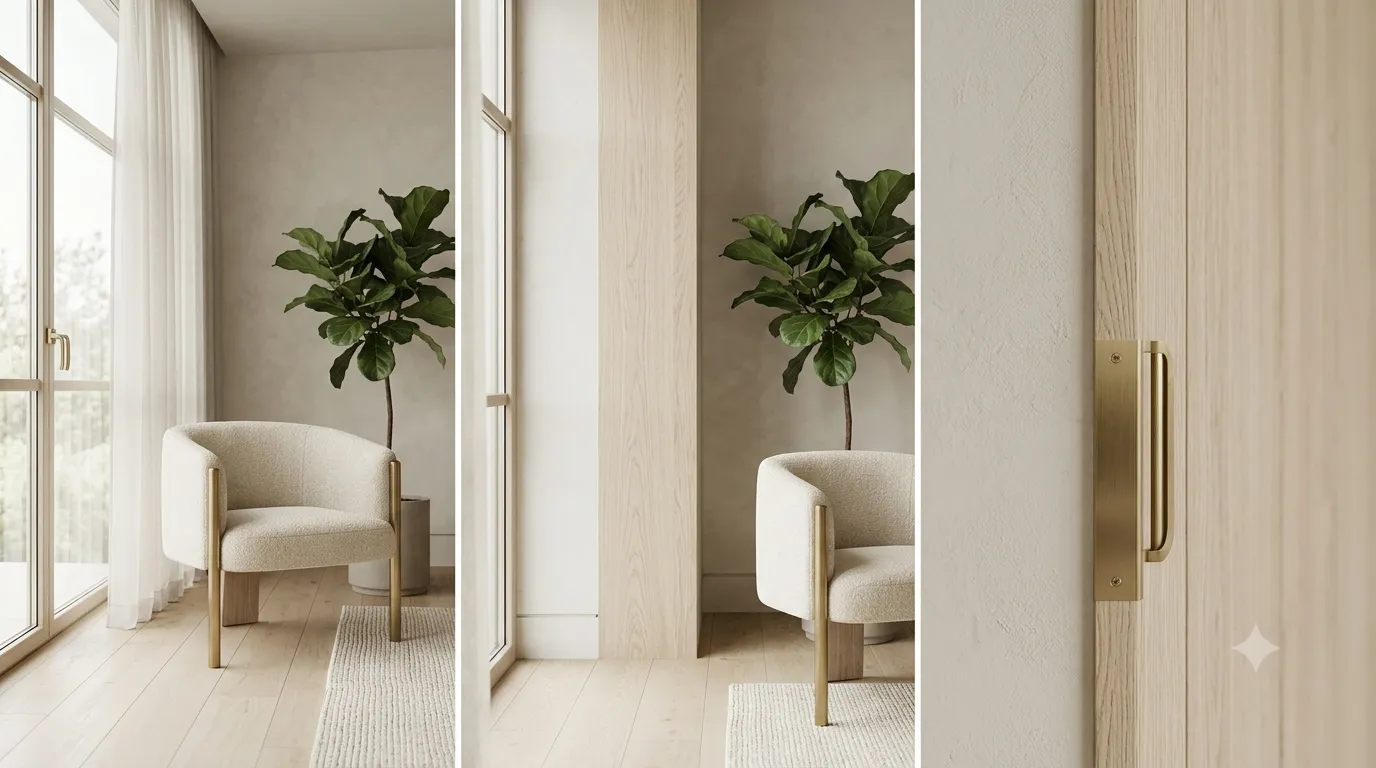
The default Latitude ships in cream bouclé. The fabric is the highest-cost material in the model — the loop weave needs both a high-resolution diffuse and a high-frequency normal to read correctly at close-up distances.
| Variant | Best room archetype | Light that flatters it | Light to avoid |
|---|---|---|---|
| Cream bouclé | Modern Italian-luxury penthouse | Warm sunset through panoramic windows | Cold north-only daylight |
| Sand linen | Coastal transitional, soft contemporary | Bright diffuse daylight | Warm dim practicals only — fabric flattens |
| Graphite weave | Evening lounge, masculine open-plan | Warm practicals, low-intensity spots | Direct overhead light — destroys texture |
| Forest velvet | Hotel lobby, formal open-plan | Cool ambient plus warm accents | Flat single-source lighting |
Cream bouclé reads correctly only when the lighting has some warmth in it. The bouclé fabric is built to absorb blue cast and turn muddy under cold daylight. A scene lit by a 6500K HDRI exclusively will produce a Latitude that looks gray and tired.
Topology and polycount
The full Latitude assembly — including the chaise — runs roughly 220k polygons. This is heavier than the Bolide (each Latitude cushion is more detailed) and lighter than the Frederick (which has modeled tufting). The chaise extension adds about 60k polys on its own.
- Continuous seat platform as a single editable mesh, so shadows cast as one piece.
- Individual cushions as separate editable groups for color and material variants.
- Chaise extension as a removable group, not a fused extension.
- Legs as simple turned geometry — designed to be hidden or replaced.
For background renders, the Latitude has a 50k-poly proxy that keeps the silhouette without the cushion detail. The proxy is silhouette-faithful but does not hold up at close-up distances.
Lighting the Latitude well
The Latitude is the most lighting-sensitive model in the Frato collection. The bouclé fabric reads correctly only under specific conditions, and getting the lighting wrong flattens the texture instantly. Three setups that work consistently:
- Sunset through panoramic windows. Warm 3200-3500K directional light from camera-left, soft fill from camera-right. The bouclé catches the sunset warmth without going yellow.
- Overhead practical with cool fill. Warm pendant overhead at 3000K, cool ambient fill from a north-facing window. The contrast sells the fabric texture instantly.
- Mixed dusk. Cool sky ambient plus warm practicals inside the room, no direct sun. The Latitude reads as an evening scene, which is its strongest genre.
Single-source daylight without warm fill is the Latitude's enemy. The bouclé fabric absorbs the cold cast and produces a flat, gray render.
Where the Latitude is the wrong answer
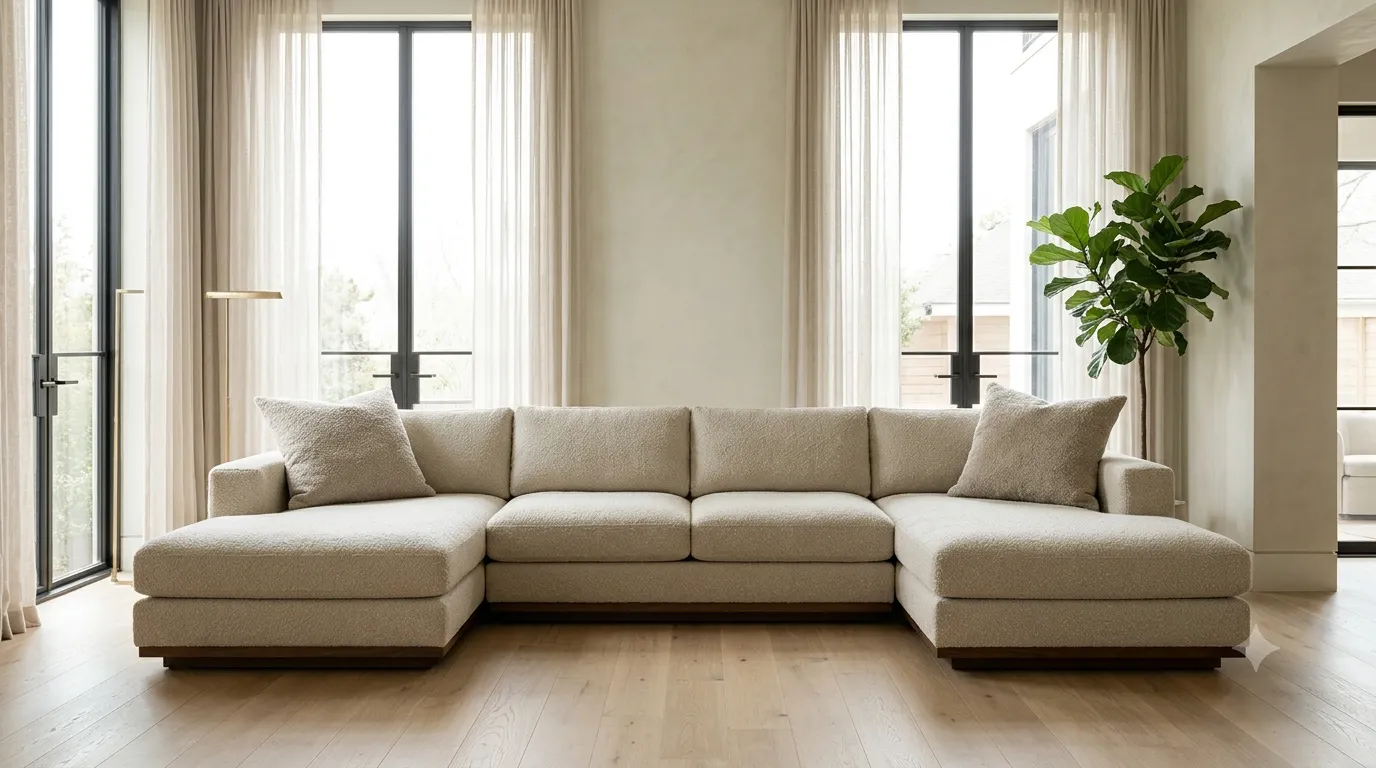
The Latitude is built for open-plan rooms with panoramic backdrops. It is the wrong sofa when:
- The room is small. A sectional overwhelms tight spaces and crowds the camera.
- The brief is Italian-classic. The Latitude reads modern — pair it with the Frederick or the Bolide instead.
- The composition has no strong backdrop. The sectional is designed to be a foreground element in front of a panoramic view; without one, the L-shape looks stranded.
- The fabric is changed to a saturated color. The Latitude silhouette wants restrained palettes; jewel tones fight the shape.
For tight rooms, pick the Bolide or the Studio chair instead. For classic briefs, the Frederick is the right hero. The Latitude is a specific answer to a specific room.
What we render it with
The Latitude ships with Corona and V-Ray material presets. The Corona preset is calibrated for warm sunset lighting and includes the high-frequency bouclé normal map. The V-Ray preset has a tighter BRDF response for cool environments.
// Roughness sweet spot for cream bouclé in Corona
// Base color:  warm cream, slight yellow bias (not pure white)
// Roughness:   0.75 - 0.85
// Bump:        high-frequency bouclé normal at strength 0.20
// Reflection:  GGX, IOR 1.45
// Sheen:       off — bouclé does not sheen
Putting it together
The Frato Latitude is the right sectional for open-plan Italian-luxury living rooms with panoramic backdrops. It is heavier than the Bolide and more lighting-sensitive than the Frederick, but for the brief it was built for, no other model on the market carries the composition as cleanly. Browse our Frato Latitude collection for the full sectional pack with chaise, mirror configuration, and bouclé variants.
Frequently asked questions
Does the Latitude work without a chaise?
Yes. The chaise is a separate editable group; removing it produces a straight sectional that works in narrow open-plan rooms. For most renders, however, the chaise is the design feature that justifies picking the Latitude over the Bolide.
Can I render the Latitude at small scales without losing the bouclé texture?
At small render scales the bouclé normal map collapses to a soft grain. This is acceptable for background renders using the proxy. For close-up shots, render at full scale — the model was built for close-up.
Is the cream bouclé the only fabric variant?
No. The asset pack includes sand linen, graphite weave, and forest velvet variants. Cream bouclé is the default because it is the design intent; the other variants are accent options for specific briefs.
