
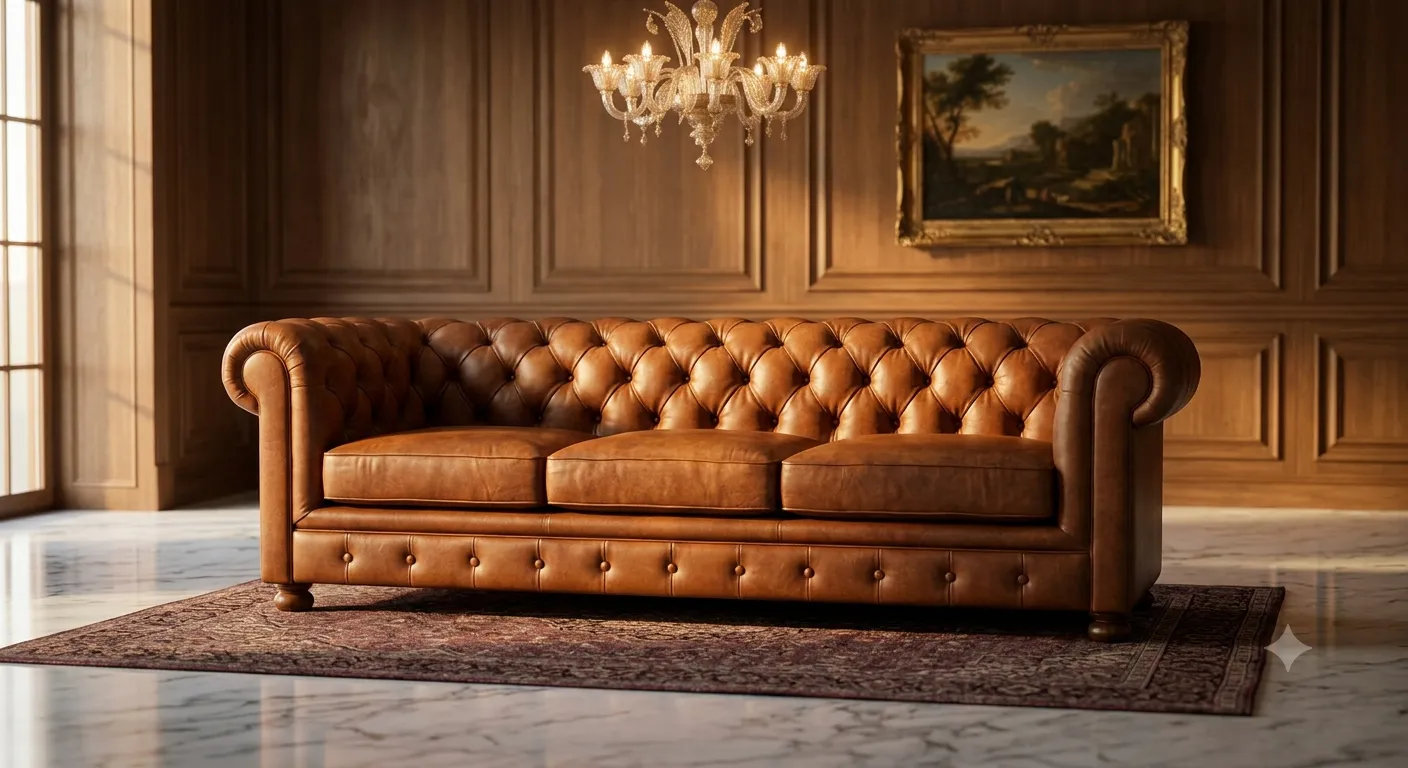
The Frato Frederick sofa is the piece most Italian-classic interior renders reach for first. Deep cognac leather, full button-tufted back, low walnut bun feet — the silhouette is unmistakable and it carries an entire room. This review covers what the Frederick 3D model gets right, where it pushes back, and the kind of scene where it stops being worth the render.
What the Frederick silhouette brings to a render
The Frederick is a chesterfield-adjacent three-seater: deep button tufting, rolled arms equal in height to the back, full leather upholstery, low turned walnut feet. In a render, the silhouette does the heavy lifting. The eye reads "old money study, leather-bound books, single malt" before the camera has time to focus on materials. That immediate read is the entire reason to pick this model.
When the brief says Italian classic or English library, the Frederick is the sofa the room wants. The render just has to get out of the way.
The model's geometry stays disciplined under that heavy silhouette. The back cushions are modeled as a single tufted plane rather than 30 separate pillows, which means the displacement reads as one continuous surface. Cushion compression is baked in, not faked with a normal map.
Topology and polycount in practice
The Frederick ships as a high-detail hero asset: roughly 180k polygons at the level interior renders need. That is on the heavier side for a sofa, but for a piece this silhouetted it is justified. The tufting geometry has enough subdivision for clean displacement, and the rolled arms hold their curve at close-up camera distances without faceting.
- Backrest tufting modeled with proper inset geometry, not normal-map fakery.
- Seat cushions as separate editable elements, with subtle compression already modeled.
- Walnut feet as solid turned geometry, not flat plane impostors.
- Stitching baked into the leather material via bump at the seam lines.
For pure hero work, the polycount is fine. For background furniture where the sofa sits behind a foreground object, drop in a proxy at 30k polys and keep the hero asset for the close-up. The model's proxy pair is included in the asset pack.
Material slots and how they hold up under light
The Frederick ships with a clean material slot structure: leather body, walnut feet, optional nailhead trim, optional piping accent. Each slot is independently editable, which matters more than it sounds. A scene that asks for black leather instead of cognac needs one material change, not a full re-texture.
| Slot | Default | What to tweak | What to avoid |
|---|---|---|---|
| Leather body | Cognac, semi-aniline | Roughness 0.45-0.55 for worn-in leather | Pushing roughness below 0.35 makes it read as vinyl |
| Walnut feet | Mid walnut with mild grain | Slightly warmer tone for traditional interiors | Over-saturated diffuse — turns into plastic immediately |
| Nailhead trim | Antique brass | Swap to polished chrome for modern interiors | Mixing brass and chrome in the same scene |
| Piping accent | Matches leather | Light contrast tone for definition | Pure white piping on a dark leather — reads as costume |
The leather material is the part that earns its keep. The base color map has the kind of subtle pull-up leather variation that only shows up under warm side light — exactly the lighting a Frederick scene usually wants.
Where the model breaks down
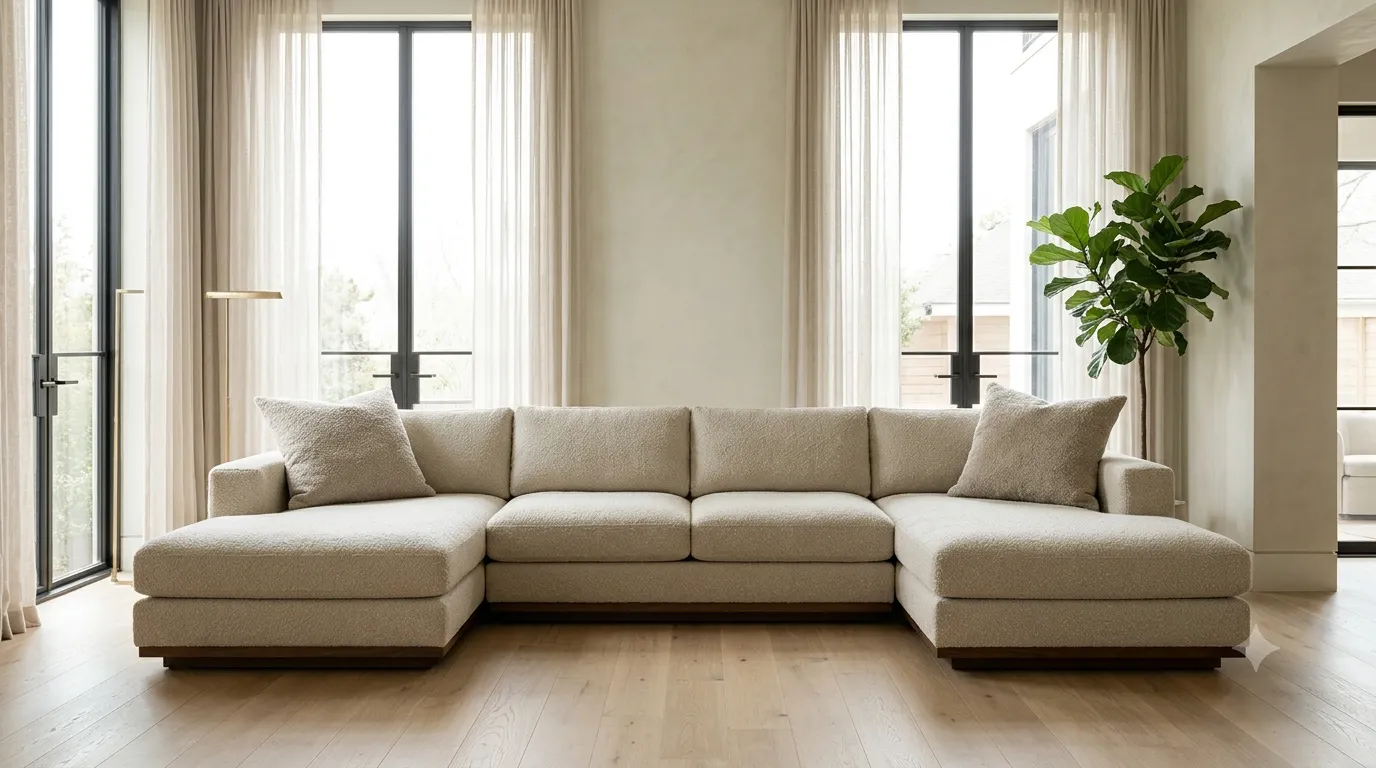
The Frederick is not a versatile sofa. Drop it into a Scandinavian interior and it looks like it wandered onto the wrong set. Drop it into a coastal scene and it reads as stubborn. The silhouette is so specific that the model is only correct in three or four scene archetypes:
- Italian classic — marble floors, Murano chandeliers, walnut paneling.
- English library — built-in bookshelves, leather armchairs, deep patterned rugs.
- Modern traditional — neutral palette, single warm focal point, restrained accessories.
- Masculine study — dark wood, brass lighting, single statement art piece.
Outside those archetypes the model still renders fine — the geometry and materials hold up — but it stops being the right answer.
Lighting the Frederick well
The leather responds to warm directional light and ignores anything else. Three lighting setups that consistently produce a clean Frederick render:
- Warm side window. Single soft area light from camera-left at 3500K. The tufting shadows deepen, the leather warms up, the room reads as late afternoon.
- Picture light overhead. Narrow spot from above-front, 3000K, low intensity. The leather top catches a soft highlight, the seat cushions fall into gentle shadow. Reads as evening.
- Mixed fireplace. Warm practical fire light from camera-right plus cool fill from a window camera-left. The contrast sells the leather texture instantly.
Cold daylight kills the Frederick. Even a 5500K HDRI through a north-facing window flattens the leather. Always warm the light at least 500K above neutral.
What we render it with
The Frederick ships with both Corona and V-Ray material presets. The Corona preset is the safer default — the leather's complex roughness profile renders faster and the tufting displacement is calibrated for the Corona displacement engine. The V-Ray preset is tuned for BRDF with a slightly tighter highlight, which suits engine-focused renders where the leather has to read clearly at small render scales.
// Roughness sweet spot for cognac leather in Corona
// Base color: warm brown, slight red bias
// Roughness:  0.45 - 0.55
// Bump:       subtle leather grain map, strength 0.15
// Reflection: GGX, IOR 1.45
// Sheen:      off (cognac semi-aniline does not sheen)
Putting it together
The Frato Frederick is a hero asset with a narrow but deep use case. If the scene is Italian classic or English library, the model is the right answer and it saves hours of model-building work. If the scene is anything else, pick a different sofa — the Frederick will fight the brief. Browse our Frato Frederick collection for the full model pack with proxy and Corona/V-Ray presets.
Frequently asked questions
Does the Frederick work as a background prop?
Use a proxy. The full-detail asset is too heavy for background furniture, and the silhouette is so specific that a generic sofa placeholder will not blend. The pack includes a 30k-poly proxy that shares the silhouette but drops detail.
Can the leather color be changed easily?
Yes. The body material is a single editable slot with no baked-in color, so swapping to black, oxblood, or forest green is a one-material change. Keep roughness in the 0.45-0.55 range regardless of color.
Is the tufting modeled or a normal map?
Modeled. The tufting geometry has enough subdivision for clean displacement, which is why the model is heavier than a typical sofa. This is the right trade-off for the silhouette.
