
The Frato Bolide is the modern counterpart to the Frederick — same Italian craftsmanship, completely different silhouette. Where the Frederick anchors a room with weight, the Bolide anchors a room with flexibility. Modular pieces, deep seats, low profile, and a fabric palette that takes modern interiors seriously. This review covers what the Bolide 3D model does well and where modular geometry gets in its own way.
What the Bolide silhouette brings to a render
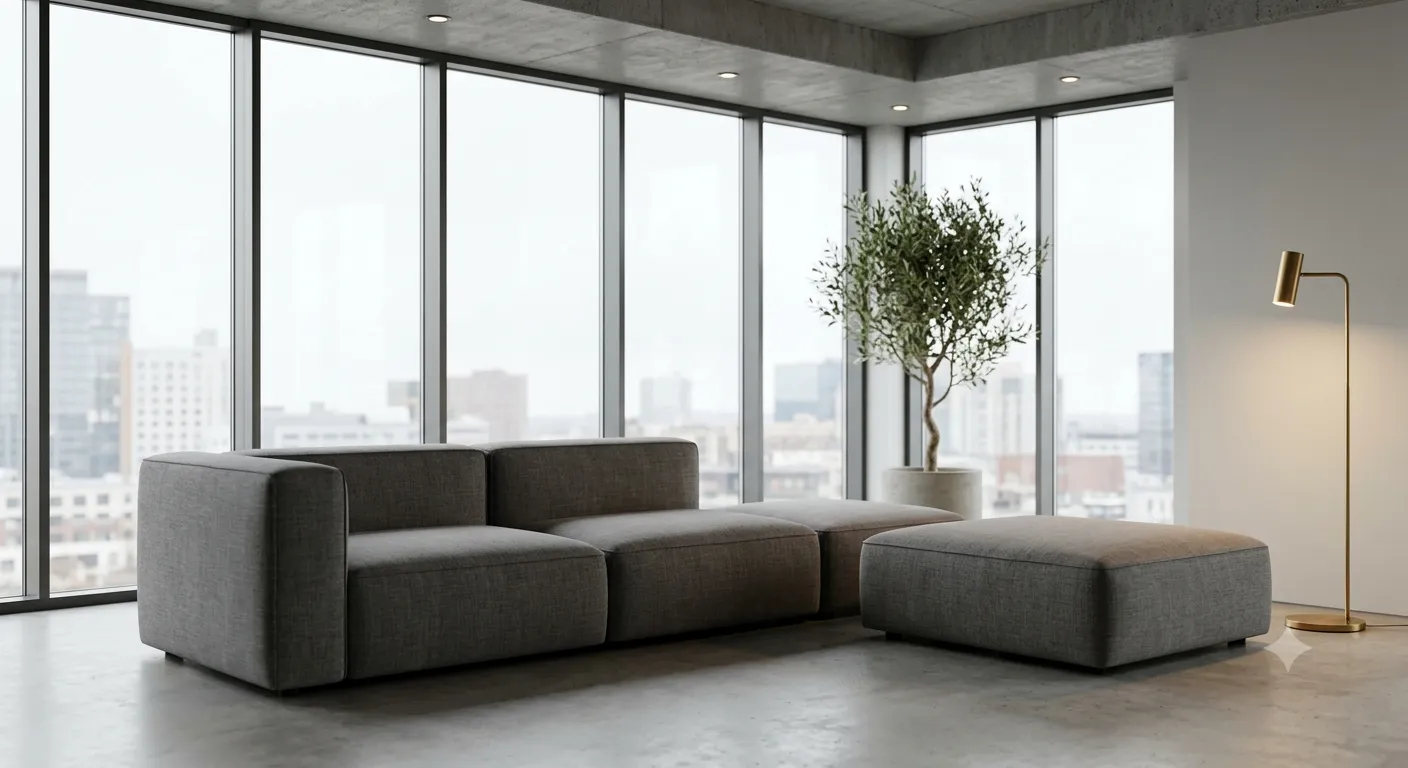
The Bolide is a low, deep-seated modular sofa with separate seat cushions, no visible arms on most configurations, and a fabric palette designed for contemporary interiors. The pieces snap together visually — the user reads a continuous sofa, but the geometry is intentionally modular. This is a render asset, not a single mesh, and it is built for scenes where the sofa composition matters.
For modern living rooms where the sofa is one of several furniture clusters rather than the hero, the Bolide is the right model. It supports the scene instead of dominating it.
The silhouette is restrained. There is no tufting, no nailheads, no decorative trim. The shape is a single horizontal plane with three to five cushions sitting on it. That restraint is the design language, and the render respects it.
Modular pieces and how they compose
The Bolide ships as a set of independent pieces: corner seat, armless middle, ottoman, chaise, and arm-end. Each piece is a separate editable object with its own material instance. For a render, this means:
- Compose any L-shape, U-shape, or chaise-extended layout by combining pieces.
- Edit cushion fabric on a single piece without affecting the rest of the sofa.
- Drop unused pieces from the scene entirely; the rest stay clean.
- Cast individual shadows per piece, which gives the modular reading at close range.
The trade-off is that you have to know which pieces you want before you start. A render that needs a specific layout requires composing two to four pieces by hand. The model is not a single-mesh drop-in; it is a kit.
Material setup and fabric options
The default Bolide ships in a graphite fabric with subtle weave variation. The material slot is per piece, so swapping a single cushion to a contrast fabric — say, a bouclé accent on the corner seat — is a one-material change. This is where the modular structure pays off.
| Fabric | Roughness range | Best room archetype | What to avoid |
|---|---|---|---|
| Graphite weave | 0.65 - 0.75 | Modern loft, open-plan | Direct warm spotlights — fabric reads flat |
| Bouclé cream | 0.75 - 0.85 | Scandi-modern, soft contemporary | Tight close-ups without displacement |
| Linen sand | 0.70 - 0.80 | Coastal, transitional | Saturated colored lighting |
| Velvet forest | 0.55 - 0.70 | Evening lounge, masculine | Harsh overhead light — destroys the sheen |
For most renders, the graphite weave is the safe default. Bouclé needs a strong normal map to read correctly at close-up distances; the asset pack includes one but it has to be activated explicitly.
Topology and polycount
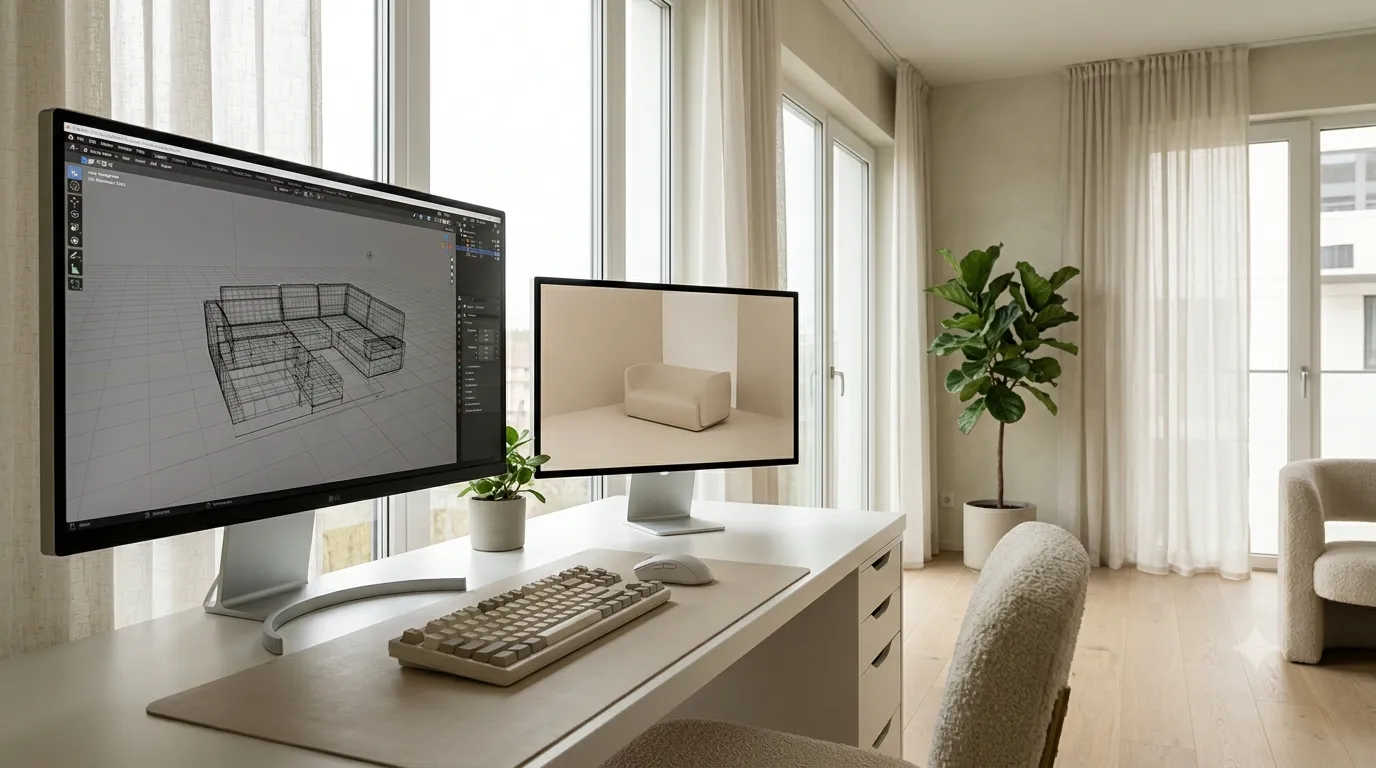
The Bolide is light for a sofa this size — each piece runs roughly 40k polygons, and a typical three-piece composition lands around 120k polys total. This is on the low side for a hero asset, but the Bolide's restrained silhouette does not need heavy subdivision. The cushions carry subtle compression as modeled geometry, not as displacement, which keeps the polycount reasonable.
- Each modular piece is a clean editable group with no merged helpers.
- Cushion seams are modeled in, not painted.
- The seat platform is a single piece across all configurations for shadow consistency.
- Legs are modeled with simple turned geometry — easy to swap or hide.
For walkthrough scenes where the camera moves around the sofa, the per-piece topology reads cleanly from every angle. There is no faceting even at three-quarter close-ups.
Lighting that flatters the Bolide
The Bolide wants north-facing daylight or soft practical lighting. Anything warmer than 4500K starts to flatten the graphite fabric. Three lighting setups that work:
- Soft north daylight. HDRI through a north-facing window at 5500-6000K, gentle fill from camera-right. Reads as a Scandinavian photo shoot.
- Overhead practical. Single warm pendant from above, 3200K, low intensity. The cushions pick up subtle highlights, the seat platform falls into gentle shadow.
- Mixed dusk. Cool ambient plus warm practicals inside the room. The contrast sells the fabric texture without flattening it.
Direct hard light is the Bolide's enemy. The fabric has soft diffuse response and crushes to flat under spotlights. Diffuse-first lighting is the rule.
When the Bolide is the wrong answer
The Bolide is not a traditional sofa. There is no rolled arm, no tufting, no decorative trim. For traditional interiors — Italian classic, English library, mid-century formal — the Bolide reads as out of place. The shape wants modern spaces with restraint.
If the brief is "modern but warm" the Bolide is correct. If the brief is "classic with a modern twist" pick a different model. Trying to compromise with the Bolide produces renders where the sofa looks lost.
What we render it with
The Bolide ships with Corona and V-Ray material presets. The Corona preset is calibrated for diffuse-first lighting; the V-Ray preset has a tighter BRDF response for cooler environments. Both include the bouclé normal map variant.
// Roughness sweet spot for graphite weave in Corona
// Base color:  warm-tinted graphite (slight brown bias)
// Roughness:   0.65 - 0.75
// Sheen:       off for tight weave, on for velvet variant
// Bump:        subtle weave normal at strength 0.10
// Reflection:  GGX, IOR 1.45
Putting it together
The Frato Bolide is the modular sofa for modern living rooms where composition matters. It is not the right answer for traditional interiors, but for everything from Scandi-modern to soft contemporary it is the cleanest model in the category. Browse our Frato Bolide collection for the full modular pack with all five piece variants.
Frequently asked questions
How many Bolide pieces do I need for a typical living room render?
Three pieces — corner seat, armless middle, and ottoman — covers most modern living room compositions. Four pieces handles open-plan scenes. Five pieces is the upper bound before the sofa starts competing with the room for attention.
Can I hide individual cushions to vary the composition?
Yes. Each cushion is a separate editable object, so removing one or two cushions is straightforward. This is useful for renders where the sofa looks more lived-in without every seat filled.
Does the Bolide have a tufted variant?
No. The Bolide is intentionally un-tufted. If the scene needs tufting, the Frato Frederick is the right model instead.
